Logbook 10/10

· 2 min read

This week we expanded SofIA’s intelligence layer by integrating Ollama for personalized recommendations and strengthening the search and indexing system for blockchain data.

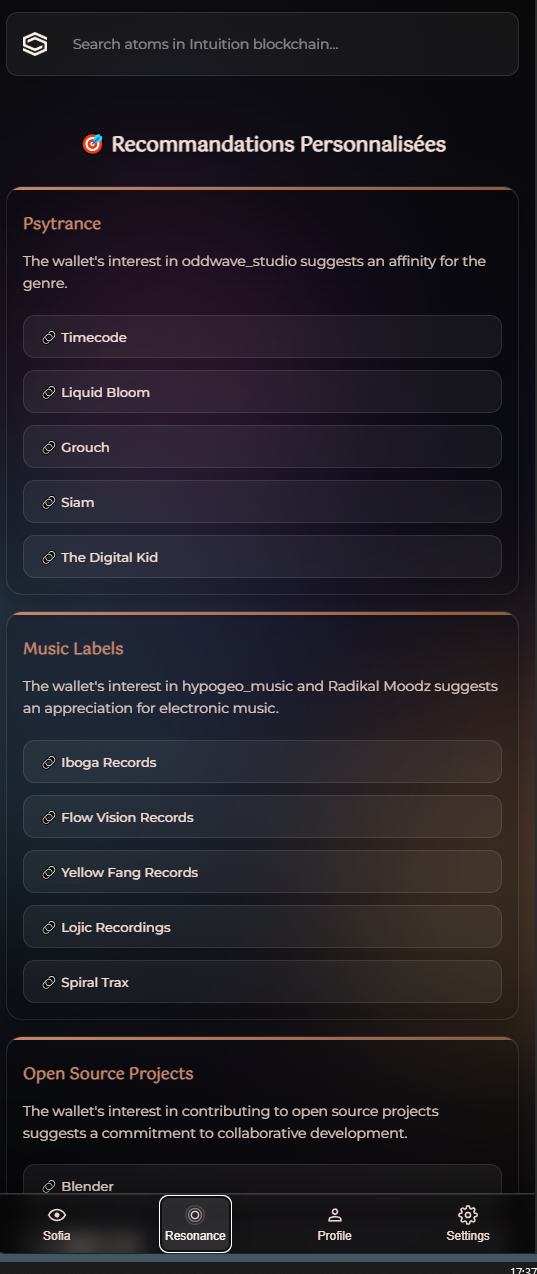
On the AI side, SofIA now features a complete recommendation engine capable of analyzing user on-chain activity and generating contextual suggestions. We implemented a double-pass strategy, producing a natural language response before reformatting it into structured JSON, and configured Ollama to accept secure requests directly from the Chrome extension. Results are now stored locally through IndexedDB, with automatic accumulation and deduplication to prevent redundant entries.

On the blockchain side, we improved the search experience with EIP-55 normalization (via Viem) for wallet addresses, ensuring consistent query results. We also unified the search bar inside the SignalsTab and optimized GraphQL queries to fetch all triples where users hold positions, making blockchain exploration faster and more reliable.

Together, these upgrades establish the foundation for adaptive, AI-driven insights within SofIA, linking behavioral patterns, blockchain data, and recommendation logic into one seamless experience.

Personalized Recommendations

Logbook 03/10

· 2 min read

This week we pushed SofIA’s front-end and blockchain layers further.
On the UI side, we continued the large CSS refactor, simplifying core pages, unifying modal styles, and ensuring a cleaner, more maintainable structure. We also introduced new interaction features such as sorting in the SignalsTab and predicate filtering in the EchoesTab, making the interface more intuitive and efficient.

On the blockchain side, the SignalsTab now fetches and displays user positions directly from the Intuition indexer, with TRUST-based upvote badges and fallback links to Portal when needed. Pulse analysis can now be published on-chain, strengthening the connection between user insights and verifiable blockchain data.

Finally, we consolidated our universal architecture by introducing a single constant for the universal “I” subject, reducing redundant atom creation, lowering gas costs, and unifying the knowledge graph into a consistent structure.

All these changes improve stability, clarity, and scalability — giving users smoother interactions and developers a cleaner foundation to build on.

Logbook 26/09

· 2 min read

During this week we pushed SofIA’s architecture further, laying the groundwork for the indexer and cleaning up our core stack. We improved gas fee handling and contract interaction, refactored our hooks and state management to be fully modular, and optimized batch atom creation to avoid duplicate blockchain transactions.

On top of that we restored the profile page, refined the Signal tab, improved CSS and integrated OAuth securely with YouTube, Spotify and Twitch. Our new theme-extraction agent now supports bookmark and history import with chunked processing for better memory usage.

All these changes make SofIA lighter, faster and easier to extend. Users benefit from smoother interfaces, quicker imports and clearer TRUST metrics; developers get a cleaner, more predictable API and message bus.

Logbook 19/09

· 3 min read

During this week we consolidated the whole Sofia extension stack. We migrated and refactored our OAuth service to a clean, dedicated structure, securing the integration with YouTube, Spotify and Twitch and making it easier for developers to configure secrets. We improved URL handling and state management, added a complete Pulse agent with its own tab and WebSocket infrastructure, and refined our detection logic to extract data . On top of that we streamlined background code, unified message handlers, added badge/notification logic and rolled out a new theme extraction agent with bookmark and history import.

The Story of Sofia

· 3 min read

From Frustration to an Innovation

We met at the Hacking Project with the goal of becoming web developers. We began this adventure in February. Both passionate about electronic music, we immediately hit it off.

In June, during a brainstorming session on our final project, Sam miraculously became bored.

After 30 minutes spent browsing meaningless ads, Instagram Reels, and random tweets, Sam realized something was wrong. The internet wasn't enriching; it was exhausting. Even with constant entertainment on the platforms, there wasn't a personal online space that felt like me.

So we asked ourselves: why are algorithms optimized for retention, not relevance? Why can't our closest friends easily recommend what matters to us?